


The Rise of Zero-Party Data and Its Impact on Marketing
- Feb 15
- 3 min read
Zero-party data (ZPD)—information customers intentionally share (preferences, needs, purchase intent, content choices)—is rising because passive tracking is weakening and users are actively restricting how their data is used. Evidence from regulators/statistical bodies and industry surveys shows both stronger user privacy actions and a parallel shift by marketers toward building their own first-party (and ZPD) assets.
Why zero-party data is rising
In the EU, more than half of internet users (54%) refused to allow their personal data to be used for advertising in 2023, indicating growing friction for ad models based on inferred/third-party signals. In the same 2023 EU data, 73% of internet users managed access to their personal data online in at least one way, reinforcing the broader move toward consented, user-controlled data collection.
Browser/platform changes also keep “signal loss” top-of-mind: the UK Competition and Markets Authority (CMA) noted the agreed delay, with Google aiming for third‑party cookie deprecation starting in early 2025 (at that time), reflecting ongoing timing uncertainty for marketers. The CMA later recorded that Google announced it did not intend to deprecate third‑party cookies, adding further uncertainty and pushing marketers to diversify into first-party and directly collected data strategies.
What secondary data shows
EU users are taking multiple steps to control personal data online—refusing ad use (54%), restricting geolocation (51%), limiting profile/content access (41%), and more.

A simple way to view the same ad-specific resistance is the split between users who refused ad data use vs those who did not

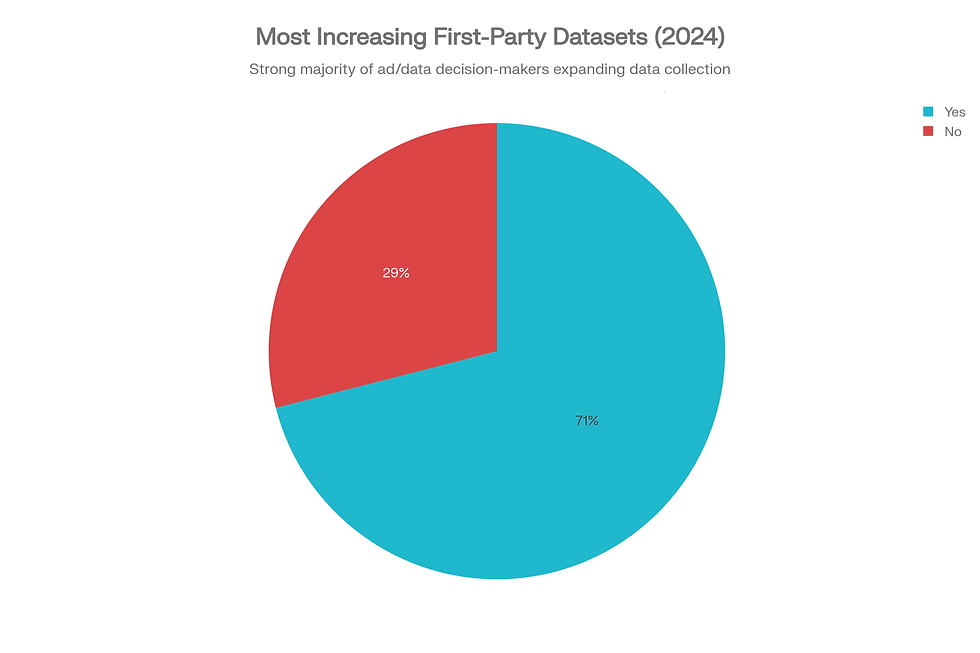
On the marketer side, IAB’s 2024 survey of advertising and data decision-makers reports that 71% of brands/agencies/publishers are increasing their first-party datasets in 2024, illustrating the industry’s investment shift toward owned/consented data (where ZPD plays a key role).
Impact on marketing (what changes in practice)
ZPD pushes targeting and personalization away from “inferred identity” toward declared preferences and intent, which can improve relevance while reducing privacy risk (because the customer explicitly provides the input). In parallel, teams typically re-balance budgets toward owned channels and experiences that earn data (quizzes, preference centers, loyalty, gated tools) rather than renting audiences via third-party targeting.
Trust and transparency become measurable growth levers: in GDMA’s US privacy report, nearly 4 in 10 US consumers (39%) put trust in an organization among the top factors that make them happy to share personal information. That means ZPD collection is not just a form redesign—it’s a value exchange (clear benefit + clear control) embedded into the customer journey.
Capture: Preference centers (frequency, categories), interactive quizzes (needs-based), onboarding surveys, wishlists/back-in-stock, “gift finder” flows, post-purchase feedback.
Activate: Build segments from declared intent (e.g., “buying in 30 days”), suppress irrelevant messaging, personalize content/product ordering, tailor offers based on stated preferences.
Because for a meaningful minority, incentives don’t outweigh the perceived downside of giving up control of personal information—especially fears about privacy invasion, misuse, and where the data ends up. That “27%” figure commonly comes from consumer surveys where a segment says they won’t share even when offered a benefit.
Main reasons people still say “no”
Privacy risk feels bigger than the reward: In a YouGov study summarized in 2025 coverage, “invasion of privacy” (32%) and irrelevant/off‑target personalization (29%) were leading deterrents around personalized messaging and data use.
Lack of trust and control: The same study notes trust as a continuing deterrent, with 27% saying they would not share their information at any point.
Fear of secondary use/third parties: Pew-based reporting highlights that even when people accept a basic “discount for data” trade, they’re often disturbed by third parties gaining control of their data and by data being sold onward.
Principle-based refusal (not a price issue): Research from the University of Pennsylvania’s Annenberg School argues many consumers reject the “fair trade” logic for data collection, and some share only out of “resignation,” while others refuse because they don’t see it as fair even with discounts.
What the “27%” also signals for marketers
That group is telling you the blocker isn’t the size of the incentive; it’s uncertainty about collection, storage, sharing, and future use—so bigger discounts may not move them. This aligns with academic findings that higher concern about how data is collected/used/stored reduces willingness to share.
If you share which survey/source your “27%” came from (link or name), I can explain the exact context, sample, and question wording driving that result.
Want tp know your next step , Let's connect!

Comments